Why A2X and Sellerboard Report Different Totals
Written by: Amy Crooymans
May 26, 2026 • 7 min read

If you run both A2X and Sellerboard for the same Amazon business, the totals won’t match, and the instinct is to assume one of them is broken.
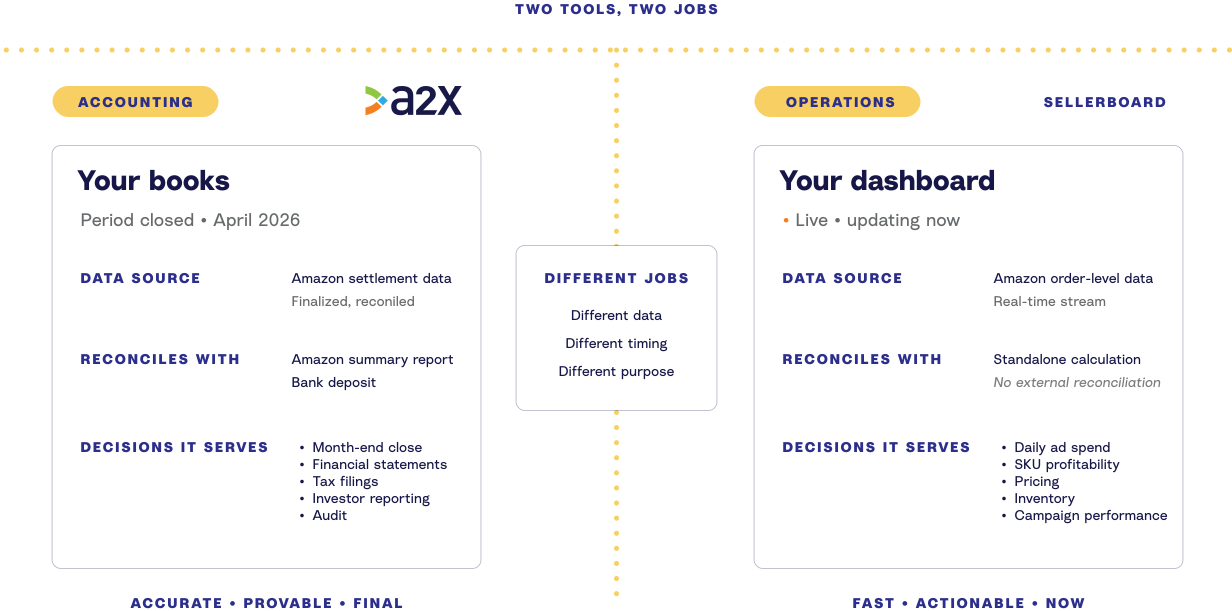
Neither is. A2X is a settlement-based accounting subledger: it reconciles to your bank feed in QuickBooks or Xero and to Amazon’s own reports, so the numbers hold up at month-end, in a tax filing, or in a due diligence pass.
Sellerboard is an order-based operations dashboard: it reports profitability in near real time so you can move fast on pricing, ads, and inventory. They read different data, on different timelines, using different definitions of profit. The gap isn’t an error. It’s the design.
This guide explains why the numbers diverge, which tool to trust for which decision, and how to verify A2X the right way. Then, if you want SKU-level profit you can actually prove, that’s where A2X Clarity comes in.
Key takeaways
- A2X and Sellerboard are built for different jobs. A2X is for ecommerce payout reconcilations; Sellerboard is an operational profitability dashboard.
- The totals diverge for two structural reasons: settlement-based versus order-based timing, and accrual versus operational definitions of profit.
- A2X waits for the settlement because settlement data is final and ties to the bank. That’s what makes it provable when you’re closing your books, in an audit, for a lender, or in a sale.
- Don’t verify one tool against the other. Check A2X against Amazon’s date range summary report and your bank deposit, the two external anchors.
- For SKU-level profit you can prove, A2X Clarity runs on the same reconciled data, so your analytics and your financials finally agree.
Why are the numbers different?
Every difference between the two tools traces back to two design choices: when each tool records a transaction, and how each one defines profit.
Timing: settlement data versus order data
A2X works from Amazon’s settlement data. When Amazon closes a settlement and sends a deposit, A2X breaks that settlement into its line items (sales, fees, refunds, tax, adjustments) and posts the summarized totals, which match perfectly with the deposit in your bank. When a settlement crosses month-end, A2X splits it, so June’s transactions land in June and July’s in July.
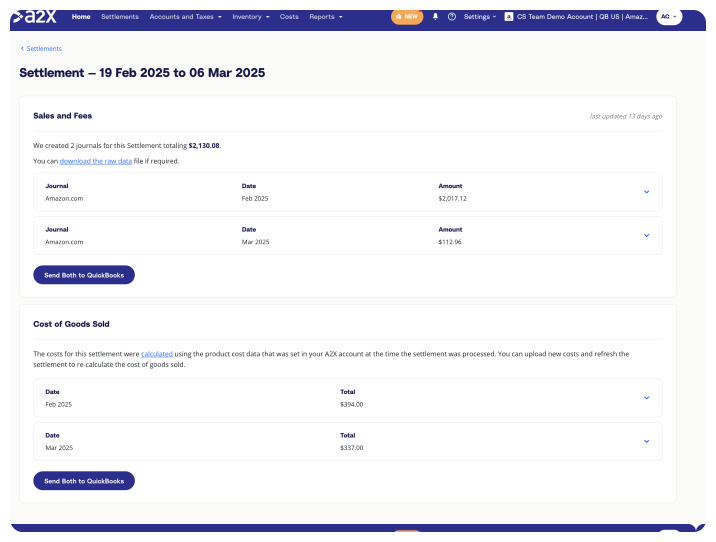
Sellerboard records transactions at the order level, as they happen. Speed is the priority. The trade-off is that Order-level data coming from a live store can shift before it settles. That’s fine for a live dashboard, but it’s the wrong basis for books a lender or buyer will pick apart. A2X waits for the settlement because settlement data is final: once Amazon closes it, those numbers don’t move.
There’s also a difference in depth. Amazon’s settlement reports carry transaction-level detail that order-level data doesn’t: hundreds of fee types, tax adjustments, reimbursements, reserve movements, marketplace facilitator offsets, and edge cases that shift as Amazon updates its policies. A2X interprets all of it, categorizes it into the right accounts, and makes the sum tie back to your deposit.
As Erin Carlson, CFO at WishingUWell, explains, anyone who has sold on Amazon knows it runs a hundred different transaction types, and A2X “really is the matching system for all of those to our general ledger.” An operations dashboard doesn’t go that deep, because a fast read on product profitability doesn’t need it.
Profit: accrual accounting versus operational margin
A2X supports accrual-based bookkeeping aligned with the FASB’s revenue recognition standard, ASC 606, and internationally with IFRS 15. It groups sales, refunds, and adjustments into accurate journal entries posted to your accounting system, giving your accountant the clean, itemized data they need to recognize revenue correctly and stand up to filings and audits.
Sellerboard calculates an operational net profit per order: COGS, Amazon fees, ad spend, and other costs netted against the sale, so you can decide whether to keep a campaign running or reorder a SKU. That’s a useful signal. It just isn’t built to produce financial statements.
Refunds, deferred funds, COGS, tax, and currency all widen the gap, for the same underlying reason:
- Refunds: A2X books a refund in the settlement that processes it. Sellerboard usually attributes it back to the original order date, which gives cleaner per-order margin but a different monthly revenue figure.
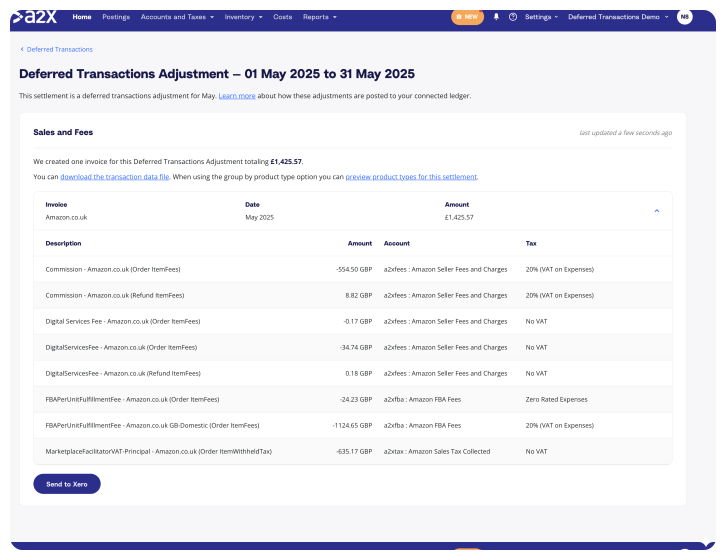
- Deferred transactions (DD+7). A2X reflects what Amazon has finalized, then posts a monthly accrual adjustment that accrues the deferred sales, fees, taxes, and COGS, with the net posting to an asset account.
- COGS: A2X posts COGS alongside the revenue in the same settlement, so gross margin and sales are for the same period. Sellerboard tracks per-unit cost in near real time for fast margin checks.
Tax and currency: Marketplace facilitator tax and multi-marketplace foreign exchange get categorized for filing in A2X and for a quick margin read in Sellerboard, so a revenue line can differ even when unit sales are identical.
Which tool to trust for which job
| A2X | Sellerboard | |
|---|---|---|
| Data source | Amazon settlements (finalized) | Order-level data (real time) |
| Timing basis | Settlement, split at month-end | Order date |
| Profit definition | Accrual (ASC 606 / IFRS 15) | Operational net profit per order |
| Reconciles to | Your bank deposit and Amazon’s reports | Not anchored to the bank or settlement |
| Best used for | Close, tax, audit, lending, sale | Pricing, ads, SKU and inventory decisions |
For anything that has to be provable, use A2X: month-end close, financial statements, tax filings, lending, investor or board reporting, your accountant’s work. Every figure traces to a finalized settlement and a bank deposit, so when someone asks where a number came from, you can show them.
For fast operational calls, Sellerboard does its job well: daily ad spend, SKU profitability checks, pricing, inventory planning. You’re not preparing statements, you’re deciding whether to raise a bid or reorder a product, and Sellerboard gives you that read quickly.
The mistake is forcing them to agree. Use each for the decision it was built for.
How to verify A2X the right way
If you want to confirm A2X is accurate, check it against Amazon’s own reports, not against another third-party tool.
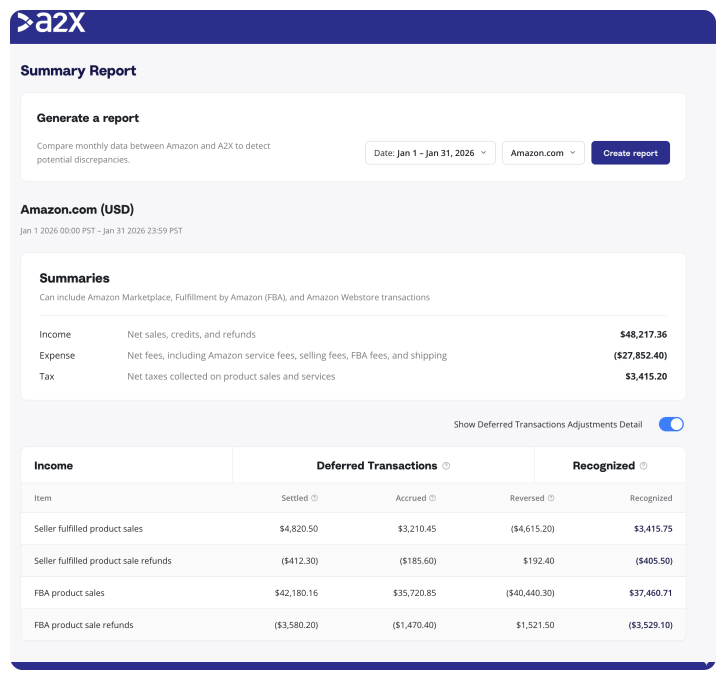
A2X’s built-in Amazon Summary Report lets you pick a date range and marketplace and compare directly against Amazon’s date range summary report in Seller Central. The two should match.
That’s two external matches: A2X to Amazon, and A2X to the bank. Whereas an operations dashboard isn’t built to reconcile to either, because that isn’t its job. For more reasoning behind why A2X posts on a settlement basis rather than importing individual orders, our support article on settlement-based posting walks through it.
Melanie Kohrs, controller at Alpha Lion, sums up the standard accountants actually hold: “As an accountant, I kind of live by the trust but verify motto. And with Clarity, I can trust the data in the reports because I can verify it.”
Provable SKU profit: where A2X Clarity fits
Some sellers want provable numbers for the operational calls too: SKU-level profitability they can trust, built on data that ties back to Amazon and the bank rather than a standalone calculation.
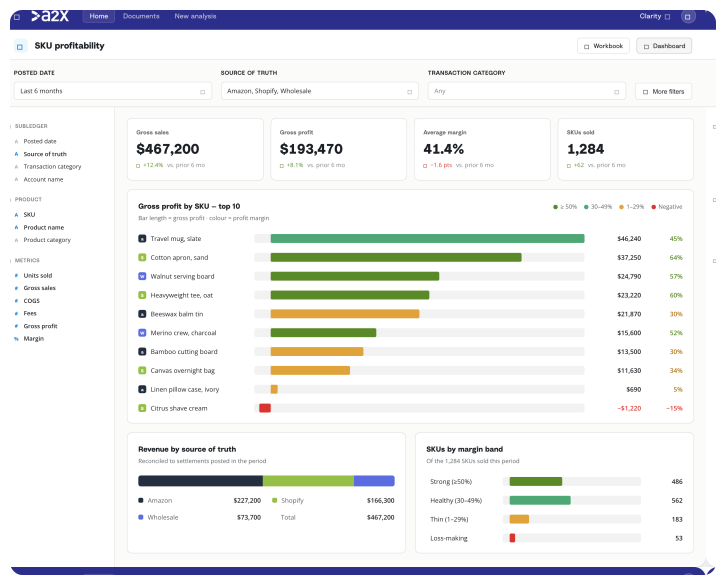
That’s what A2X Clarity is for. Clarity is a SKU-level profitability subledger: per-SKU margin, product-level profitability, and contribution analysis, built on the same settlement-based, reconciled data that powers your books. One data source, one timing model, no gap between what your analytics say and what your financial statements say.
Cindy Smith, CPA and founder of AC Ecommerce Accounting, on what reconciled-to-the-cent data does for confidence: “I really like to know that everything is penny perfect. Now I feel very confident about how the data is reflected in the financials.”
See your Amazon books reconciled to the source
Get a settlement-based record that ties to Amazon’s reports and your bank, with SKU-level profit you can prove. Start a free trial of A2X and see your next settlement reconciled to the cent.
Run books for Amazon sellers? Become an A2X partner and give every client numbers that hold up at close, in an audit, and in a sale.
Frequently Asked Questions

Save hours on your ecommerce accounting
A2X connects your sales channels and accounting software for fast and accurate monthly bookkeeping.
Try A2X today
ABOUT THE AUTHOR
Amy Crooymans
Amy Crooymans is the Product Marketing Manager at A2X. A member of the A2X team since 2020, Amy brings 10 years of marketing experience to the team and specializes in making complicated ecommerce accounting topics simple to understand. See for yourself in her A2X YouTube videos! Amy works closely …