Why A2X is the Most Comprehensive Ecommerce Accounting Software for UK Sellers
Written by: Elspeth Cordray
March 11, 2026
If you sell on Amazon, Shopify, eBay, or Etsy, you’ve likely already experienced the challenges that come with ecommerce accounting. It’s a constant battle with marketplace fees, rolling refunds, payment delays, cross-border VAT, OSS reporting, and increasingly complex compliance rules.
While almost every accounting app claims to be the “best” or “easiest,” the reality of ecommerce at scale requires more than just basic automation.
For UK sellers, especially those dealing with cross-border EU sales, One Stop Shop (OSS), or a complex Chart of Accounts, A2X is widely considered the most comprehensive and robust ecommerce accounting software on the market. When comparing A2X to alternatives (such as the Xero or QuickBooks integrations, Link My Books, etc.), the difference ultimately comes down to scalability and accuracy (A2X) versus cost savings.
Let’s dive into why scaling sellers and accounting firms in the UK choose A2X for their ecommerce accounting.
Key takeaways:
- A2X ensures complete, audit-proof UK and EU VAT compliance. Unlike basic tools that rely on rigid tax buckets, A2X offers granular tax mapping, true accrual accounting for EU One Stop Shop (OSS) sales, and daily gateway summaries to meet HMRC’s strict Making Tax Digital (MTD) rules.
- A2X powers flawless accrual accounting for scaling ecommerce businesses. It automatically manages complex financial hurdles – such as Amazon’s Delivery Date + 7 (DD+7) reserve policy, dynamic refund calculations, and precise Cost of Goods Sold (COGS) tracking – to deliver an accurate, real-time Profit and Loss (P&L) statement.
- A2X scales alongside your growth by streamlining bank reconciliation and unlocking deep business intelligence. By grouping transactions to perfectly match actual marketplace payouts, A2X turns bank reconciliation into a one-click process while upgrading your operations from basic bookkeeping to advanced, SKU-level profitability analytics.
1. The 9-box VAT return: Granular control vs. basic buckets
Before diving into how software handles your data, it’s crucial to understand the anatomy of a UK VAT return. The standard HMRC return consists of 9 boxes, but for most ecommerce sellers, the heavy lifting for revenue happens in these four boxes:
- Box 1 (Output VAT): This is the actual amount of VAT you’ve charged and collected on your sales, which you now owe to HMRC.
- Box 6 (Net Sales): This is the total net value of all your sales and outputs (excluding the VAT itself). This must include your standard-rated sales, but also your zero-rated sales and exports.
- Box 4 (VAT Reclaimed): This is the VAT you’re reclaiming on your business expenses. Crucially, this includes the VAT on your marketplace fees, which directly offsets the total sales VAT you owe in Box 1.
- Box 7 (Total Purchases): This is the total net value of your purchases and business expenses (excluding the VAT), which includes the net value of those marketplace fees.
The most practical hurdle for UK sellers is accurately separating marketplace income to populate these four boxes.
The alternative method (basic buckets)
Tools focused on extreme simplicity often hard-code their logic to fill these boxes. They automatically group all sales into strict buckets (e.g., Standard Rated, Zero Rated, Marketplace Facilitator).
- The limitation: While this prevents basic errors, it lacks the customisability required by scaling sellers. If your business has a unique tax setup, sells mixed-VAT bundles, or your accountant wants revenue split by specific product categories or regions on your Chart of Accounts, hard-coded buckets cannot accommodate you.
The A2X method (flexible mapping for scaling sellers)
A2X provides the raw data directly from the marketplace and allows you to map it precisely how you want. You can tell A2X that “Sales to Germany” maps to a specific “Zero Rated” tax rate, while “Sales to USA” maps to “No VAT.”
- The benefit: Unmatched flexibility. Whether you use Xero, QuickBooks, Sage, or a heavy-duty ERP like NetSuite, A2X lets you build your tax mapping exactly to your accountant’s specifications. A2X bends to your business model, not the other way around.
Does this mean my A2X mapping will be really difficult and complicated?
It’s a fair question. The phrase “manual mapping” usually sends shivers down an ecommerce seller’s spine. While some tools focus on extreme simplicity and basic groupings in comparison, it may seem that A2X would require tedious setup or manual templates, but the reality is the opposite. For UK sellers who just need to submit a standard UK VAT return, A2X provides an off-the-shelf onboarding option that literally takes seconds to set up called ‘ Assisted Setup’.
The difference is what happens next. When you inevitably need more granularity, and as your business grows, A2X doesn’t lock you out. It provides the most robust and user-friendly mapping interface on the market to make custom configuration painless.
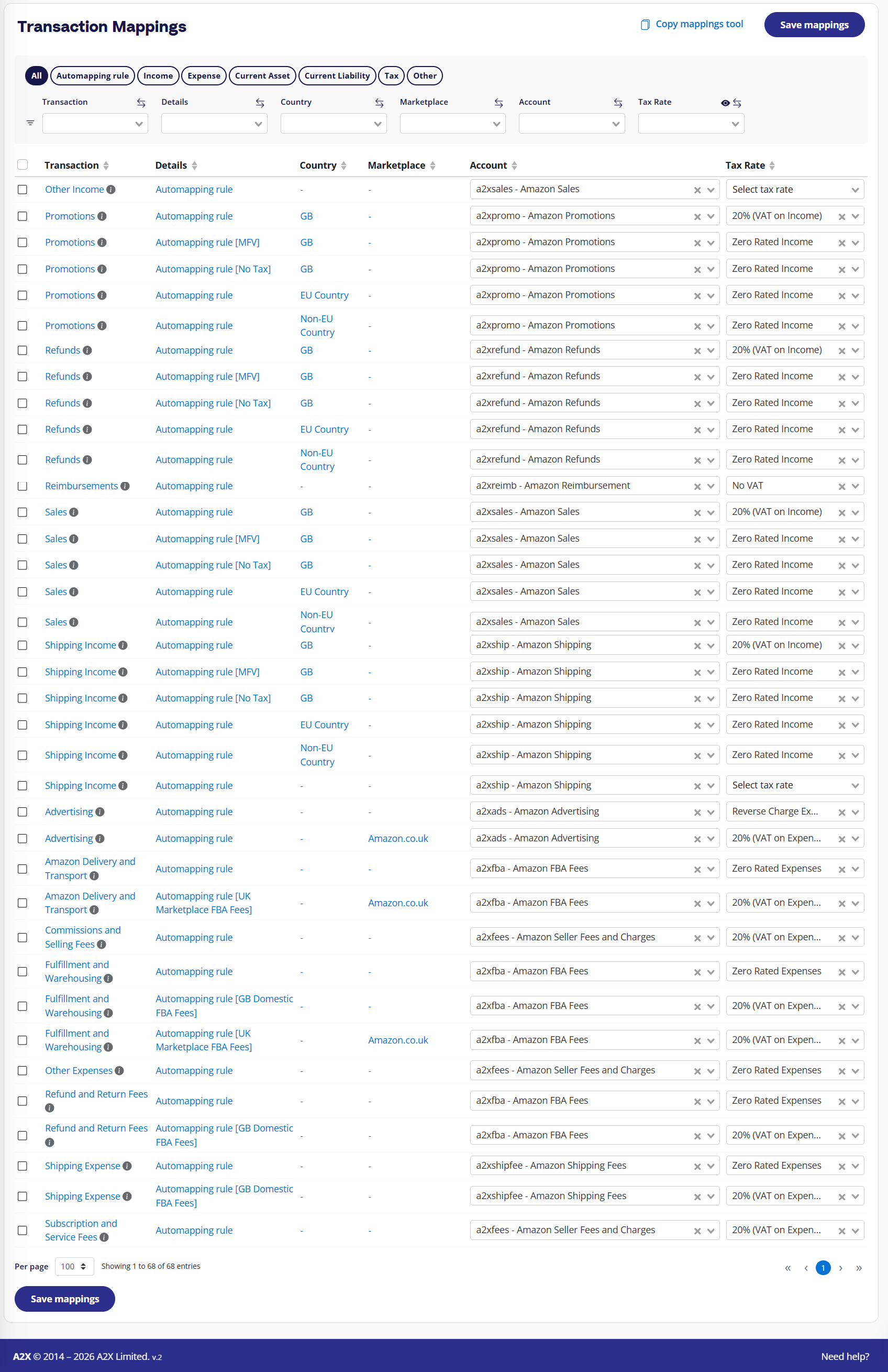
Instead of scrolling through thousands of messy lines of data, A2X provides a highly structured mapping page where you can slice and dice your data precisely how you need it. You can filter by:
- Accounting categories – Isolate your Income, Expense, Current Liability, Tax, or Other accounts.
- Transaction types – Instantly pull up all Sales, Promotions, Refunds, Tax, or Shipping Income.
- Granular details – Filter by specific transaction details, Country (crucial for OSS/EU sales), Marketplace (e.g., Amazon UK vs. Amazon DE), store (e.g., online, manual order, POS, or payment gateway transactions), Account Type, and Tax Rate.
Once you have filtered exactly what you want to see, you don’t have to click line by line. You can simply use A2X’s Bulk Actions to highlight everything on the screen and map your preferred chart of accounts and tax rates in a single click.
Want more details about VAT mapping in A2X? Here are a few helpful guides:
The magic of automapping rules
Once you map a transaction type, A2X’s Automapping Rules take over. A2X saves your logic and automatically applies those exact account and tax rules to all future transactions that match that criteria. It’s completely “set it and forget it.”
Even better, Automapping acts as a safety net. Ecommerce marketplaces are notorious for inventing new, unexpected fee types without warning. If Amazon suddenly introduces a brand new type of logistics fee, A2X won’t blindly shove it into a generic expense bucket (which could mess up your tax return). Instead, because there is no automapping rule for this unseen fee, A2X catches it, leaves it blank, and flags it for you to map correctly before it hits your accounting system.
2. Handling EU VAT and OSS: True accrual vs. the “adjusting journal” method
Since Brexit, holding stock in the EU or handling cross-border EU sales via OSS has become incredibly complex. How your accounting software handles this dictates your daily financial visibility.
The alternative method (the adjustment VAT journal approach)
A common workaround for growing UK sellers managing EU sales is relying on a manual journal adjustment. But how does this happen in the first place? Often, the culprit is the middleware pushing your data into your accounting software. For example, out-of-the-box apps often see an EU sale, know it doesn’t belong on the UK VAT return, and simply push the total amount into a revenue account mapped as “No VAT” or “Out of Scope.”
- The flaw: When this happens, your daily revenue is artificially inflated. You don’t see your true net sales until the end of the reporting period when your accountant manually calculates your One Stop Shop (OSS) return and posts an adjustment VAT journal to back the tax out of your revenue.
The A2X method (the accrual approach)
A2X calculates your EU VAT liability immediately based on the shipping destination, or, in the case of Amazon, the Taxable Jurisdiction determined by Amazon. Through custom rules, A2X posts the journal entry with the VAT already separated into a liability account (e.g., “VAT Payable - Germany”).
The benefit: Real-time accuracy. Your P&L is completely accurate day-to-day because the tax liability is stripped out immediately. You know exactly what belongs to the tax authorities and what belongs to you.

3. Deep integration with Amazon’s VAT Calculation Service (VCS)
If you use Amazon VCS, Amazon calculates the VAT at checkout. Both A2X and standard alternatives read this data from Amazon’s VAT Transaction Report.
However, A2X is the preferred choice for many sellers because it doesn’t just pass the totals along – it allows you to map those specific VAT lines to highly complex tax code structures. If your business is scaling to the point where you need precise, audit-proof ledgers across multiple jurisdictions, A2X provides the necessary depth.
4. Making Tax Digital (MTD) compliance: The “daily summary” requirement
Compliance with HMRC’s Making Tax Digital (MTD) rules is non-negotiable. However, UK sellers who offer multiple ways to pay (Shopify Payments, PayPal, Klarna) can experience some challenges.
The alternative method (the monthly summary trap)
To avoid software bloat, many basic tools simply group your sales into one monthly summary.
- The compliance concern: While consolidating data into a single monthly entry might seem efficient, it raises compliance flags. Based on advice from UK accounting experts and HMRC guidance, posting daily summaries for third-party payment gateways (like PayPal, Klarna, and Clearpay) is the most acceptable approach for Making Tax Digital (MTD). While direct payouts from marketplaces like Amazon or Shopify are treated differently, rolling weeks of third-party gateway sales into a single, long-term entry is highly likely to flag a concern during an HMRC VAT inspection.
The A2X method (daily gateway splitting & the digital link)
A2X isolates every single payment gateway into its own specific entry and allows you to configure them to post as daily summaries.
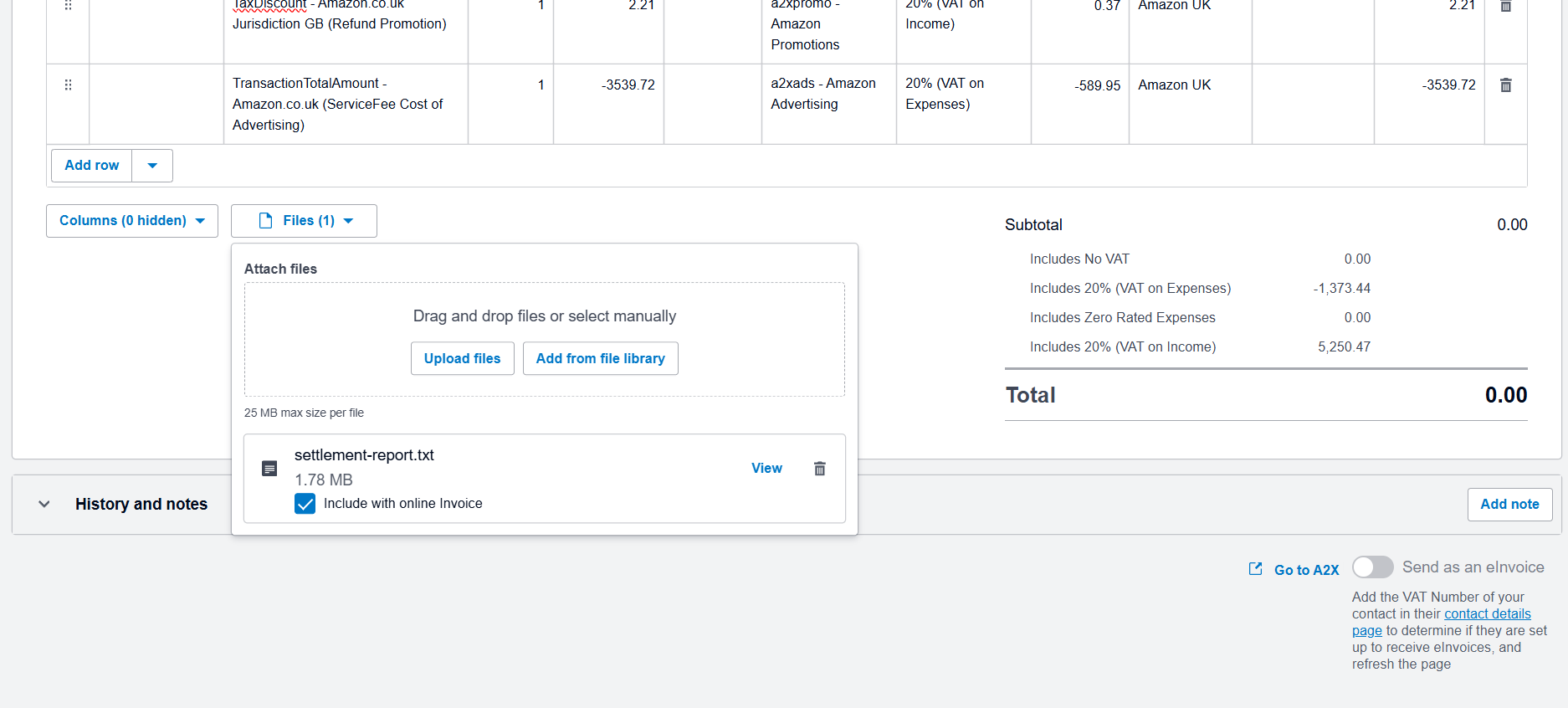
The unbroken digital link: When A2X posts these daily entries, it physically attaches the raw, itemised data file directly to the journal entry. If HMRC audits your VAT return, the exact breakdown of how your figures were calculated is sitting right there on the Chart of Accounts, perfectly preserved without any manual spreadsheet manipulation.
5. Amazon’s DD+7 policy: True accrual vs. cash chaos
Amazon has been rolling out its Delivery Date + 7 (DD+7) policy more broadly, withholding funds in reserve until seven days after an item is delivered. If your accounting tool doesn’t handle this properly, your monthly P&L can become unreliable.
The alternative method (cash-based lag)
When Amazon defers a transaction, holding funds due to DD+7 or B2B payment terms, basic tools have no way to capture it. Without identifying transactions in a deferred state, those sales, fees, and COGS are simply absent from your books until Amazon releases them. A sale made in January may be deferred and not released until February, meaning it goes unrecorded in January and only hits your books in the wrong period. This could understate January revenue, inflate February, and make your gross margins and inventory tracking unreliable as a result.
The A2X method (automated deferred adjustments)
To solve this without breaking your bank reconciliation, A2X introduced automated Monthly Adjustments for Deferred Transactions. At the end of the month, A2X posts a single adjustment per marketplace that captures the movement in and out of deferred transactions, accruing sales, fees, taxes, and COGS for transactions that were deferred during the month, and reversing those that were released. The net impact posts to an asset account you choose, keeping your P&L and Balance Sheet accurate. Your settlement postings remain completely untouched, so bank-feed matching continues as normal. This feature is available on all A2X for Amazon plans.
- The benefit: You get perfect accrual accounting while your day-to-day settlement postings remain clean for easy reconciliation.
6. True profitability: Advanced COGS and refund handling
A2X doesn’t just track your top-line revenue; it masters your Cost of Goods Sold (COGS) to give you a real-time view of your true bottom line.
The A2X advantage:
- Flexible cost upload options – Not every business is ready for an enterprise inventory management system, and A2X meets you exactly where you are. You can easily pull your product costs into A2X through multiple flexible workflows. Sync your costs directly from Shopify, link a live Google Sheet, or set up an automated Cloud CSV feed. This ensures your COGS data is always accurate and easy to update, regardless of how you prefer to manage your supply chain.
- Dynamic refund adjustments: When a customer returns an item, basic tools often just record the negative revenue but fail to reverse the cost of that item out of your COGS. This artificially deflates your profit margins. A2X automatically adjusts your COGS entry value when a refund is processed, ensuring your gross margin reporting is always perfectly accurate.
- Landed costs and IMS integrations: As your operations mature, A2X scales with you. It works flawlessly with Inventory Management Systems (IMS) like Cin7.
7. Transaction grouping: Payout matching vs. Chart of Accounts swamping
How your software groups transactions dictates how much time you spend reconciling your bank feed.
The alternative method (order syncing or messy summaries)
Basic native integrations push every single individual order into Xero or QuickBooks.
- The limitation: If you process 10,000 orders a month, this will swamp your Chart of Accounts and slow your software to a crawl. Furthermore, trying to manually match thousands of daily sales against one arbitrary lump-sum bank deposit is a reconciliation nightmare.
The A2X method (settlement-based grouping)
A2X groups transactions to perfectly match the actual payout/settlement from the marketplace. It bundles all the sales, refunds, fees, and taxes that make up that exact deposit into one summarised journal entry. When the cash hits your bank feed, it’s a one-click perfect match.
- The “Month-End Split” benefit – If an Amazon payout period spans from January 28th to February 4th, A2X automatically splits the data into two separate journal entries. This ensures January’s revenue stays in January, maintaining strict accrual accounting rules.
8. Trust but verify: Built-in reconciliation reports
A common anxiety with automated accounting is the “black box” effect: data goes in, numbers come out, and if something doesn’t match your sales channel, you’re left hunting for the error.
Unlike simplified alternatives, A2X includes built-in verification tools that allow you to compare A2X’s data directly against the sales channel’s native reports.
- The Amazon Summary Report: A2X generates an internal report that perfectly mirrors the Date Range Summary Report generated inside Amazon Seller Central. This allows you to lay the two reports side-by-side to verify that every settlement has been received and properly processed, instantly identifying any accounting system discrepancies.
- The Shopify Reconciliation Tool: Because third-party Shopify apps (like return portals or upsell plugins) can alter orders after they’re placed, data variances can occasionally occur between your store and your ledger. A2X features a virtual Finance Summary Report that replicates Shopify’s own data. If a discrepancy is found, A2X’s Reconciliation Tool doesn’t just give you an error code; it pinpoints the exact, specific orders causing the variance and suggests possible reasons.
9. A2X scales with you: From bookkeeping to business intelligence
One of the biggest mistakes ecommerce sellers make is choosing software they will outgrow in a year. A2X is uniquely designed to scale alongside your business.
For early-stage and growing sellers, A2X Core provides everything you need to automate your bookkeeping, nail your VAT returns, and keep your P&L accurate. But as your order volumes explode and your operations become more complex, you don’t need to rip out your accounting stack. You can simply upgrade to A2X Clarity – a premium Business Intelligence (BI) and double-entry subledger designed for advanced sellers.
A2X Clarity sits on top of your financial data, providing investor-ready reporting broken down into two distinct superpowers:
- Advanced reconciliation – When you’re processing massive order volumes across multiple channels, or integrating with a heavy-duty ERP like NetSuite, finding a discrepancy can take days. Clarity’s Advanced Reconciliation auto-matches payouts to specific orders and SKUs. If there is a variance between Shopify and your ERP, Clarity flags the exact order causing the issue, turning a multi-day month-end close into a process that takes minutes.
- Profitability analytics – Standard accounting software tells you that you made a profit; A2X Clarity tells you how you made it. It provides near real-time, SKU-level and channel-level profitability dashboards. By normalising fees, taxes, and COGS for every single item, you can instantly identify loss-leader SKUs, analyse specific ad-spend efficiency, and track exactly which products are driving your bottom line.
A2X has a proven track record of success in helping prominent UK brands scale – customers such as Applied Nutrition have shared how A2X turns time-savings and accuracy into growth.
The future of A2X
A2X isn’t just the best tool today; it’s continuously evolving to meet the ecommerce demands of 2026 and beyond. Keep an eye out for these three (and many more) game-changing features:
Faster Month-End Close for Amazon
Currently, Amazon sellers often have to wait until the settlement period closes before they can finalise their books; sometimes that is well into the following month. We know this is a pain point for Amazon sellers, so we’re working on a solution that will allow you to finalise your Amazon month-end close faster, giving you your financial reports days earlier than the competition.
Shopify Deferred Revenue (fulfillment-based)
Recognising revenue the moment an order is placed isn’t always the right approach, especially for pre-orders, made-to-order products, and businesses operating on accrual accounting. A2X is introducing deferred revenue support for Shopify using automated month-end adjustments. At the close of each month, A2X defers revenue for unfulfilled orders into a Deferred Revenue liability account, and recognises revenue for orders that were fulfilled during the month, covering product sales, shipping, discounts, and COGS. Your books reflect when revenue is truly earned, without any manual exports or journal entries.
The verdict
If you’re a smaller UK seller with a highly standard setup who just wants the VAT boxes filled with minimal thought, guided automation tools do a great job.
However, if you’re a scaling business, hold inventory in the EU, have COGS requirements, or need real-time, audit-proof P&L data capable of handling Amazon’s DD+7 policy and MTD daily regulations, A2X is the gold standard.
See what all the fuss is about. Start your free trial of A2X now.
Frequently Asked Questions
FAQs about A2X for UK Ecommerce Sellers

ABOUT THE AUTHOR
Elspeth Cordray
Elspeth Cordray MICB PM.Dip is a Certified Bookkeeper, ecommerce specialist, and the UK Go-To-Market Manager at A2X, an award-winning ecommerce accounting automation solution. Named Bookkeeper in Industry of the Year 2024 by the Institute of Certified Bookkeepers, she knows how to help businesses …