Ecommerce Accounting Guide for Business Owners [2026]
Written by: Amy Crooymans
January 6, 2026 • 48 min read

Most sellers don’t start their online businesses with ecommerce accounting in mind, but understanding your numbers is essential to running a profitable, resilient business.
Ecommerce accounting can be more complex than traditional retail accounting because sales channels and payment processors change the flow of funds. Instead of a clean “customer pays you” transaction, ecommerce businesses often receive bundled payouts that net together sales, fees, refunds, and other activity. That means your bank deposits rarely tell the full story of what happened in your store.
This guide covers the fundamentals so you can build clean, decision-ready books from day one.
What you’ll learn:
- What ecommerce accounting is (and why it’s different)
- What ecommerce accounting involves (bookkeeping, tax, analysis)
- Cash vs. accrual vs. modified cash accounting
- Tools and information you need to get started
- How to do ecommerce accounting
- Understanding your business profitability & performance
- When to hire an ecommerce accounting specialist
If you have questions, reach out to the A2X Support Team at contact@a2xaccounting.com. Or, find an ecommerce accounting specialist via the A2X Ecommerce Accountant Directory.
What is ecommerce accounting, and how is it different?
Ecommerce accounting is the process of recording, organizing, and reconciling an online store’s financial activity so you have an accurate record of money moving into and out of the business.
What makes ecommerce different is the role of sales channels (Amazon, Shopify, Walmart, Etsy, eBay, etc.) and payment processors. These systems often:
- Bundle many orders into a single payout
- Deduct fees before you ever see the cash
- Net refunds and adjustments against sales
- Pay on a delay (days or weeks after the sale)
Because deposits are bundled, your bank feed won’t tell you the underlying details. The details live inside the sales channel, and accurate ecommerce bookkeeping requires you to categorize and reconcile the components that make up each payout.
Here’s a deeper dive to exemplify some of the differences.
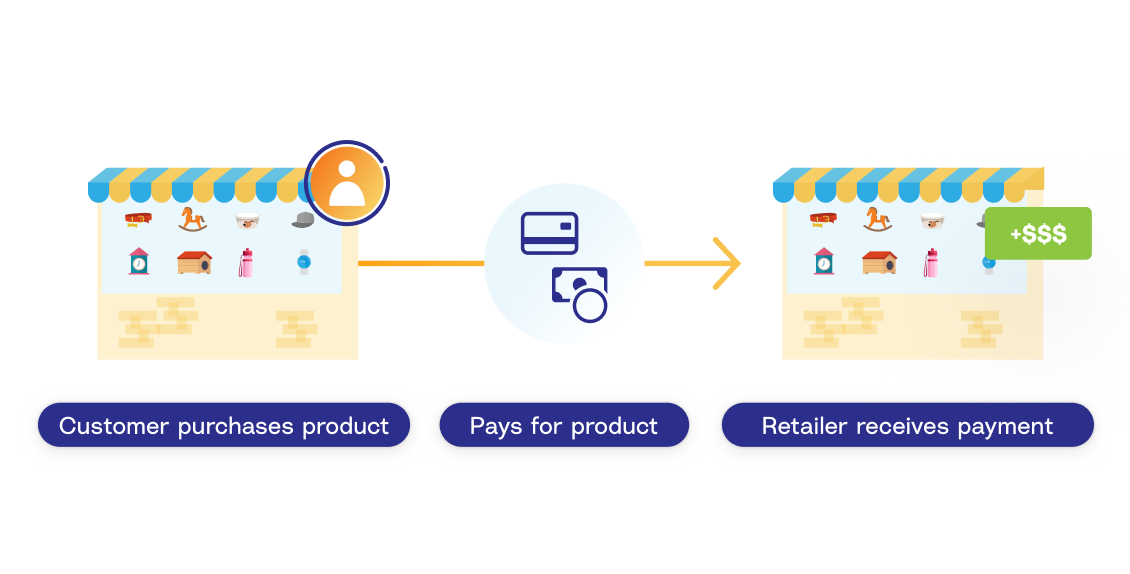
In traditional commerce, a customer goes into a brick-and-mortar store, purchases a product, and pays the store directly.
In ecommerce, a customer buys a product, and the store’s payment gateway processes the payment. The payment gateway takes a percentage of the purchase price as a fee for facilitating the sale. Instead of depositing the remaining amount into the retailer’s bank account immediately, it holds the funds and makes a delayed lump sum payment. These lump sum payments often comprise money from multiple sales and could be deposited days or weeks after the transactions occurred.
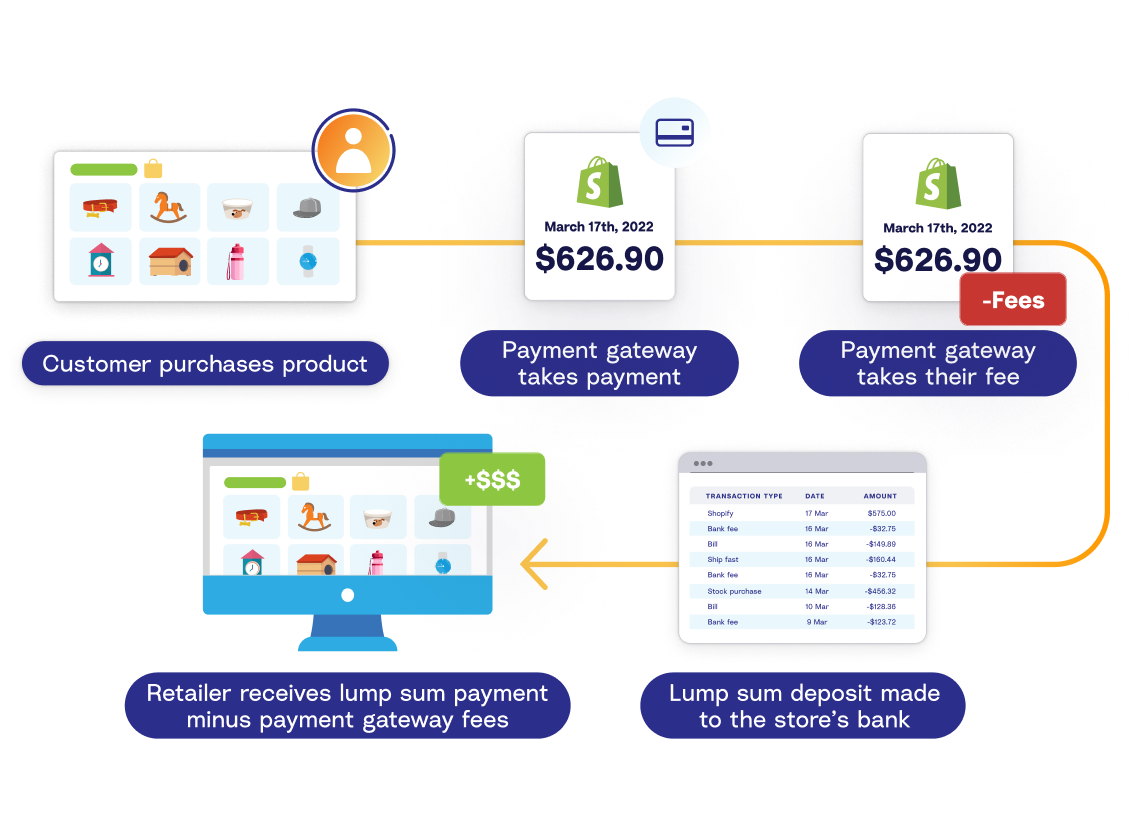
Because the money from the sales channels is deposited in a lump sum, looking at an ecommerce retailer’s bank account won’t give you detailed information about what took place, e.g., sales, returns, fees, and shipping costs.
All of that information is on Amazon, Shopify, or your sales channel of choice. Skills and knowledge are required to categorize and correctly reconcile what’s in the bank account with the transaction types on the sales channel.
Here’s an example of some of the transactions that might have occurred in a Shopify lump sum payment.
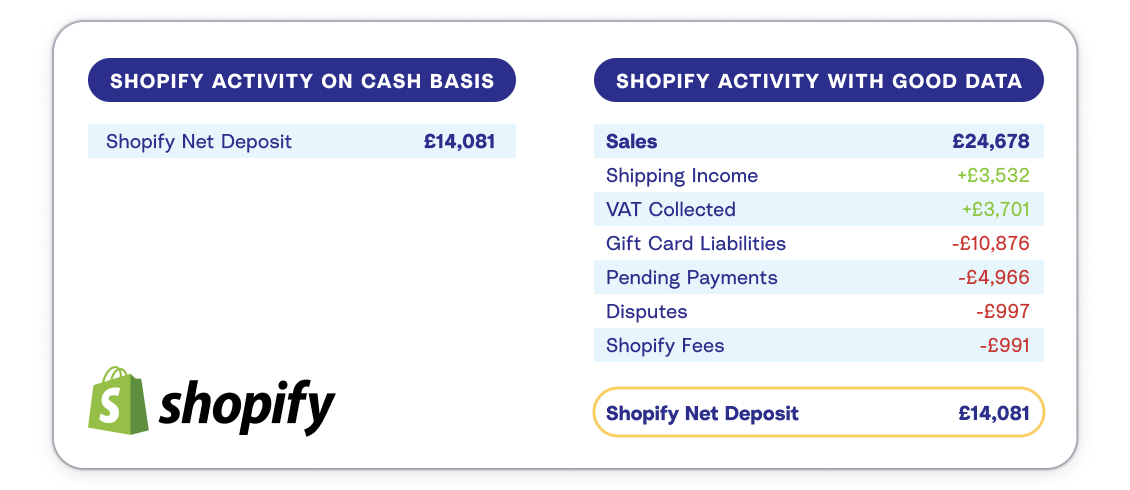
While the actual fees and transactions included in this example may differ for other sales channels (e.g., Amazon), the concept remains the same: The lump sum payment isn’t just sales. It’s actually a combination of sales, fees, refunds, shipping income, etc.
Incorrectly recording the entire lump sum payment as “sales” or “income” could cause you to over or under-report on your actual numbers, which could then cause you to over or under-pay any relevant taxes, and will result in incorrect financial data that could also cause you to make poor business decisions.
For an overview of the basics, watch this video where we answer some FAQs about ecommece accounting.
What does ecommerce accounting involve?
When you think of accounting, your mind probably goes straight to taxes, but that’s only part of what’s involved in ecommerce business accounting. Let’s take a closer look.
Bookkeeping
Bookkeeping and accounting are often used interchangeably, but they cover different tasks that feed to a common goal.
Bookkeeping is the day-to-day work of recording transactions and reconciling them to real-world sources (bank statements, sales channel payouts, credit cards, etc.). Clean bookkeeping is what enables reliable financial reporting and confident decisions.
If you’re looking to outsource your ecommerce bookkeeping, there are many bookkeeping firms who specialize in working with ecommerce businesses. (Many accounting firms also specialize in working with online sellers, and also offer bookkeeping services.)
Get detailed steps on how to complete bookkeeping by watching the following videos:
- Step-by-step guide to Shopify bookkeeping in Xero
- Step-by-step guide to Shopify bookkeeping in QuickBooks Online
- Step-by-step guide to Amazon bookkeeping in Xero
- Step-by-step guide to Amazon bookkeeping in QuickBooks Online
Tax management and compliance
Understanding your tax responsibilities as an ecommerce business can be difficult, especially when you’re selling into different tax jurisdictions.
Managing taxes for an ecommerce business involves:
- Registering for sales tax and/or VAT in the regions where a company has tax obligations
- Calculating and filing quarterly and year-end taxes/VAT
- Collecting, tracking, and remitting tax and/or VAT
- Managing any international tax/VAT/GST obligations
- Staying informed on any updates to tax law and regulations
- Handling tax audits or disputes
We strongly recommend working with an expert when it comes to managing sales tax and VAT.
The following resources can also help you get familiar with the sales tax/VAT obligations that might apply to you:
- Managing US Sales Tax for Shopify
- The Ultimate VAT Guide for Amazon Sellers in UK & EU
- Shopify VAT: How to Do it Right
Inventory and COGS
For product-based ecommerce businesses, inventory and Cost of Goods Sold (COGS) are the bridge between “cash received” and “true profitability”.
Sales channel payouts show what cash hit your bank after deductions, but they do not tell you whether what you sold was profitable. To understand profit, you need accurate COGS in the same periods as the related sales.
How inventory flows through your financial statements:
Inventory is typically recorded as an asset on your balance sheet until it’s sold.
- When you buy inventory, the cost is usually recorded to Inventory (balance sheet).
- When you sell inventory, the cost moves from Inventory to COGS (P&L).
This is one reason accrual (or modified cash) accounting tends to be more useful for inventory sellers (more about this below).
Learn how to build a best practice inventory accounting workflow for ecommerce.
Returns, refunds, and inventory adjustments
Returns affect both revenue and inventory economics. The correct accounting depends on what happens to the item (returned to stock, written off as damaged, lost, etc.), and businesses using FBA or 3PLs often need a consistent approach to inventory adjustments.
Financial analysis and growth planning
Every business should regularly analyze their finances and plan for growth – and ecommerce businesses (who are perhaps deciding whether they should cash flow or exit) are no exception.
This aspect of ecommerce accounting involves looking at product profitability, finding opportunities to increase profits, setting and evaluating growth-related metrics, and forecasting cash flow. This analysis helps businesses make better financial decisions, such as when to purchase inventory and if they can afford to hire employees. It also ensures preparedness for periods of slow business, as well as when to seek funding or external investment.
There are a few keys to effective financial analysis and planning:
- Good data – Ensure your bookkeeping data is correct by using the right tools and ensuring you’re capturing all sales, expenses, and other transactions.
- Ecommerce accounting expertise – Work with a specialist who has experience building and analyzing reports specifically for ecommerce businesses. They’ll know which numbers are most important to reaching your goals.
- Benchmarking – Clean books tell you what happened. Benchmarks tell you whether what happened is normal, strong, or a warning sign. Benchmarking is especially valuable in ecommerce because margins and expenses can shift quickly due to ad costs, promotions, shipping changes, returns, and inventory cost volatility. (Good news – we have a whole series about ecommerce financial benchmarking!)
Ecommerce accounting methods: cash, accrual, and modified cash
An accounting method refers to the practices and procedures used to record financial transactions, maintain records, and generate financial statements. Choosing the right method is crucial for making informed decisions about your business’s finances, as it impacts the accuracy of financial forecasting and the data available for analysis.
Let’s explore the most common bookkeeping methods. These methods use double-entry bookkeeping, where each transaction must have at least two general ledger accounts assigned, which balance and offset each other.
Cash accounting
With the cash accounting method, income is recognized when you receive money from a sale, and expenses are recorded when money goes out. With this method, you only account for income or expenses when the cash is exchanged, which makes it easier to understand your cash flow.
Example: Your store receives an order for 500 pairs of summer sandals. The shoes are manufactured and shipped to the customer who pays the invoice 30 days later. If you’re using cash accounting, you would record the income for these sandals when the customer’s payment is in your account, despite being a month since they received the sandals and more than a month since you received and prepared the order.
Accrual accounting
Accrual accounting is more suitable for businesses dealing with inventory. This method requires you to record revenue from sales when they occur, not when the cash is received. A similar process applies to expenses. Accrual accounting helps you understand the long-term impact of inventory purchases and sales on your financial performance.
Example: Your store receives an order for 500 pairs of summer sandals. The shoes are manufactured and shipped to the customer who pays the invoice 30 days later. With the accrual method, the income for the sandals is recorded as the day the sandals were shipped to the customer, as this was the completion of the sale. The income is recorded as an account receivable and will be settled when the customer pays 30 days later. This payment is recorded as a cash inflow.
Modified cash accounting
Modified cash accounting – sometimes referred to as the “hybrid method” – uses both the cash and accrual method for different types of transactions. With modified cash, you would handle operating expense transitions using the cash accounting method and revenue and Cost of Goods Sold (COGS) using the accrual accounting method.
The modified cash method gives you a more accurate view of profitability than cash accounting on its own would, and is less time-consuming and complex than accrual basis. It’s typically best suited to businesses in the $1-25 million revenue range.
What accounting method should ecommerce sellers use?
As an ecommerce seller, using accrual or modified cash accounting is recommended, which provides a more accurate picture of your cash flow and enables better financial forecasting.
Most accounting software and tools, including A2X, organize your books using accrual accounting by default, making it easier to prepare for your business’s financial ups and downs.
Additionally, once a business is doing more than $25 million in annual revenue, it is required by the IRS to use the accrual method. Many lenders and investors will also require financials to be prepared on an accrual basis.
What tools and information do you need to start ecommerce accounting?
Setting up your finances should be a top priority for an ecommerce business owner, and it’s a good idea to set up your finances properly as you’re establishing your business.
Here are a few key items to get sorted so that it’s easier to do your ecommerce accounting:
Business tax ID number: If you run a partnership or corporation in the US, you’ll need an Employer Identification Number (EIN) from the IRS. Or, if you’re in the UK, you’ll need a Unique Taxpayer Reference (UTR) from HM Revenue and Customs (HMRC), and possibly an Economic Operator Registration and Identification (EORI) number, which is used to track and register customs information in the UK and EU.
Business bank account: One of the biggest mistakes new businesses make is mixing personal and business finances. It can be tempting to use an account you already have, but you’ll likely regret that decision when it comes to untangling your finances. Instead, set up a dedicated business account.
Accounting software: If you’re just getting started, you may get by using spreadsheets to manage your bookkeeping, but as your online sales grow, finding the best ecommerce accounting software for your business will help save time as you track sales, expenses, inventory, and taxes and will generate the necessary financial reports for you. Among small businesses and experts, Xero and QuickBooks Online are two of the most popular cloud accounting software solutions.
A2X has also provided a breakdown of the best accounting software for Amazon sellers and the best accounting software for Shopify merchants.
Important note: Most accounting software will require a third-party integration to get your sales and transaction data from Shopify, Amazon, and any other sales channels into your accounting software. It’s important to consider automating this process as manual entry can take a lot of time and is prone to human error. Consider using an integration tool like A2X to help – it will make your ecommerce accounting and bookkeeping easier and more accurate!
How to do ecommerce bookkeeping
Ecommerce accounting is easiest when you treat it like a repeatable system: get the right tools in place, automate the messy parts (sales channel settlements), build a reliable inventory and COGS workflow, then close and review on a consistent cadence.
Here’s an in-depth ecommerce bookkeeping checklist; below, we’ve listed some tasks you should complete regularly:
- Record sales activity accurately: Capture sales, discounts, shipping income, and sales tax correctly (especially when payouts are bundled).
- Record expenses consistently: Categorize key spend like ads, shipping, software, and sales channel fees.
- Handle returns and chargebacks properly: Record refunds, returns, and disputes so revenue and liabilities aren’t overstated.
- Reconcile regularly: Match bank and credit card activity to your books and reconcile sales channel payouts so deposits are explained.
- Produce your financial statements: Generate your P&L, balance sheet, and cash flow statement on a consistent cadence.
- Review performance and cash: Track metrics like gross margin, net margin, and inventory turnover (if you hold stock) to spot trends and issues early.
- Stay compliant on tax: Plan for income tax and manage sales tax/VAT collection and remittance where required.
- Budget and keep clean documentation: Maintain a working budget and keep receipts, invoices, and supporting reports organized.
- Benchmark at the end: Once your books are clean, compare your P&L and key metrics to relevant ecommerce benchmarks so you can quickly see what’s “normal” for your size and model, and where to focus (gross margin, ad spend, overhead, and profitability).
Can ecommerce accounting be automated?
Parts of ecommerce accounting can absolutely be automated. A2X automates ecommerce bookkeeping by turning payouts from Shopify, Amazon, eBay, Etsy, Walmart, and PayPal into accurate summaries that match to payouts in your accounting software (QuickBooks Online, Xero, Sage, and Netsuite).
Scott Scharf, an Ecommerce Optimization Consultant at Scharf Consulting, walks through what ecommerce accounting automation actually looks like for best-in-class brands in this video:
Hey everyone, my name is Geoff and I'm the head of marketing here at A2X, e-commerce accounting and automation
0:10
software for the world's leading Shopify, Amazon, eBay, Etsy, and Walmart sellers as well as their accounting
0:16
partners. And speaking of partners, uh I'm joined here today by Scott Sharf from Sharf Consulting. Um Scott is an
0:24
expert in helping e-commerce sellers streamline and optimize their back office. Uh he helps businesses with
0:30
their accounting processes in tech stack which is going to be a lot of the focus of what we're going to be talking about
0:35
today. Uh he also helps folks select the right inventory management solutions uh which can get really hairy. He provides
0:43
entrepreneurial coaching uh and a ton more. And if Scott looks familiar to
0:49
many of you um there's a reason for that and it's because uh Scott has been in
0:54
the e-commerce accounting space for well over a decade. He was actually the co-founder of Catching Clouds, one of
1:01
the first, if not the first, uh, specialized e-commerce accounting practice in the United States. Um, so,
1:09
you know, just to kind of TLDDR this, if you're an e-commerce business owner, uh, and you want help optimizing your back
1:14
office administration, Scott is your go-to resource. And, uh, we've included a link in the description below to his
1:20
website. So, if you want to get in touch, please do so there. Scott, um, thank you so much for joining us on on
1:27
today's video. and uh for sharing your expertise. No, thank you, Jeeoff. It's always fun collaborating both with you
1:32
and uh the whole team at A2X. Okay, so in this video, we're going to talk about what automated accounting actually looks
1:38
like for e-commerce sellers in 2025. Most sellers that are watching this probably didn't start an online store to
1:45
do the accounting or or get caught up in the back office administration of it all. So the idea of automated accounting
1:51
is is really appealing because in theory you get the benefits of accurate numbers to help you make informed decisions uh
1:58
and you don't have to deal with the admin headaches. But the challenge with e-commerce accounting automation is that
2:05
it lives on a spectrum. Every single person probably has a different definition depending on the tools and
2:10
technologies that they're using. Some solutions deliver a part of the process. Others make uh bold claims that they can
2:17
do all of it. but don't necessarily deliver. And with the proliferation of AI, things are getting even a little bit
2:24
more confusing. So, Scott, I'm going to start off the video with this question for you. What does automated e-commerce
2:30
accounting mean to you? And how much of the process can we actually truly automate? Yeah. So, um, when it comes to
2:38
e-commerce accounting, it's it really means that that data is flowing in automatically that either you or your
2:45
accountants aren't waiting until the end of the month and downloading data and pivoting data or making guesses or doing
2:51
other things. Is there still a need for actual bookkeepers and accountants and controllers, especially controllers who
2:57
are going to make sure that all the numbers come together and tie together and then can tell you a story about what
3:03
happened in the current month based on this accurate data. But you're not paying for as many humans to be doing
3:10
data entry for them to double check things where things can where things aren't accurate because somebody broke
3:16
your spreadsheet and the calculations wrong and all of that other stuff. What it means to me is you have a consistent
3:23
way where there's daily, weekly, monthly processes for you to run your business and for the data to flow cleanly,
3:29
consistently in in an integrated way into your general ledger and that you can trust it. I love that. And I know
3:35
that you have a very clear view of what this actually looks like in practice. So I'd love for kind of my next question to
3:42
be could you show us that view like what is your ideal automated e-commerce accounting setup looks like uh look like
3:49
and then could you walk us through uh the process? Sounds great. Let's do it.
Automated Accounting Setup for DTC
3:54
So there are a number of key functions on top of just the regular accounting when it comes to e-commerce. Okay. Um
4:01
the first is how are you going to post your income? You know, if you sold 100 items, did you get paid for all those
4:07
hundred items and reconcile to cash? Okay. And that's really where A2X comes
4:13
in. And depending on how you look at it, that's probably the first third of e-commerce accounting on top of all the
4:19
regular accounting. Okay. The next key function is how are you going to post
4:24
your cost of goods sold? Okay. So, I sold 100 widgets at $10. I need to
4:30
reduce my inventory by $1,000. So I know if I sold X amount,
4:36
how profitable I am. Okay. Then the next piece that more than likely probably
4:42
starts first, which is have you when you purchase products, how do you account
4:47
for them properly? Okay. And then the last little piece is any inventory adjustments and then some very specific
4:53
month-end close that has have to be done uh you know by the accountants to make sure the balance sheet balances vendor
5:00
deposits accurate inbound inventory and a number of these other details. So looking at this at this image in the top
5:07
left you've got your channels. So this first one is specifically for a direct to consumer only and then we'll talk
5:12
about if you're also doing wholesale as well on the next slide. So, what it's going to do is A2X is going to pull in
5:18
all of that income for Shopify, Amazon, eBay, Walmart, Etsy, and it's going to
5:24
post it into a summary invoice either per day or a couple invoices per month
5:30
following acrual rules. And in my opinion, uh, instead of posting every
5:35
single invoice where you have to apply a payment and track every single invoice in your accounting, this is about 5% of
5:43
the work is to have A2X post this in a summary fashion. Especially because both
5:48
Zero and and QuickBooks uh, QBO aren't set up to accept thousands or tens of
5:55
thousands of orders. It's just noise. What you care about is I sold 10 units.
6:02
Did I get paid for 10 units? And A2X specifically does that very well. I've
6:07
been working with them for over a decade. And that you end up with that data. And so for Amazon and eBay, uh,
6:13
Walmart and Etsy, they're going to post those based on the settlement statements from match all the pennies and allow you
6:18
to map everything from sales income to shipping income to discounts to refunds and Amazon FBA reimbursements and other
6:25
items. So all the accounting gets mapped properly and it gets put in the right buckets in a limited number of buckets
6:31
so it's easier to manage. In the case of Shopify, it's going to post a daily invoice that's going to match your
6:38
Shopify pay output to the penny which includes fees and everything else. And any other payment processors, it's going
6:45
to put those into a clearing account. So, what it's going to do is it's going to optimize income getting into your financials with the least amount of data
6:52
or invoices or journal entries so that you have accurate income that you can reconcile and track back to know that's
6:58
accurate. Okay? If you're wondering, well, why don't I do that with another tool or the inventory management system?
7:06
They also have a copy of every order. The difference is is that those tools are looking at every order. You want
7:12
every order in your inventory management system. And even if they do a consolidation, they're going to
7:17
consolidate based on a 24-hour day or a week or a month. That does not break it
7:23
into the pieces that accountants need to as efficiently as possible make sure that the money going in and out of your
7:29
business is accurate. Okay. So, and then with A2X, you have the option is you can
7:36
upload your costs into A2X if you don't have an inventory management system. you currently have spreadsheets and you
7:42
don't really trust your spreadsheet calculations to to create the number for your cost of goods sold, you can upload
7:48
those costs into A2X and it'll post the historical cogs for all of your orders, both historically and as you move
7:55
forward. As long as you keep those costs accurate and up to date and that's really going to cover about 60% of the
8:00
e-commerce accounting, you're most of the way there and you can continue to work off spreadsheets. But as we were
8:06
talking before, there's a point where you need that automation to make sure you're managing how you're purchasing
8:12
inventory and you have a trusted source. So an inventory management tool is going to do a few key things. It's going to be
8:17
a trusted source for purchase orders where you purchase all your products. Every purchase order, even if you make a phone call to somebody and they're
8:23
sending it to you and you don't email them anything, you want to create something that's tracking, I've
8:28
requested this inventory, it's showing up at some point in time, a thousand widgets or whatever else. Okay. The next
8:35
critical thing is knowing your costs. And this is the foundation of having accurate numbers. This is the most common thing that goes out of control is
8:42
when people switch from buy costs. I spend $10 for a widget versus it
8:47
actually cost me $30 after it's shipped from Vietnam or Japan or wherever.
8:52
Coming back over, that's your landed cost where you take the buy cost and you add in any inbound shipping, any
8:59
insurance, and any customs and tariffs and duties, which are a big deal now, to
9:04
make sure you know the total cost of that product when it's sitting in your warehouse. So, you don't sell it for
9:11
less than it paid you to make it live and available in your warehouse. So the inventory management system is going to
9:17
allow you to know the vendor, the buy cost, the quantity, the SKUs, and you'll be able to add those additional costs
9:23
and be the trusted source for costs. The next thing it's going to be is the trusted source for your inventory
9:29
quantities. When you receive inventory or you sell inventory, it's the one that's going to keep track of that.
9:36
Anybody that's on spreadsheets and if you're working with a third party uh 3PL warehouse, an external warehouse, you
9:42
can't just trust their numbers. And it's sometimes it's not trust but verify. It's trust but or don't trust and say
9:49
wait there should be another hundred units. Where are they? This is a big deal. Many people move off of
9:56
spreadsheets to an inventory management system because they're working with the 3PL and they have no other way to
10:02
validate their numbers and they know there's something wrong with the numbers from the 3PL. I had a seller who had
10:08
$50,000 of inventory just disappear because the the warehouse reported it
10:14
and we looked and it just disappeared financially because it wasn't reported to us. It had just disappeared. It took
10:21
four months until the 3PL did an audit and found a cage full of his other product. He had already bought another
10:26
year's worth of product. So these are one of the key things. But once it does that, then you can have the accounting.
10:32
So, to take a step back, the inventory management tool is going to pull in every order. It's going to push
10:38
inventory quantities up as well as shipping confirmations and manage that portion of it. So, you're going to buy
10:44
product, you're going to receive product, it's going to update your inventory, it'll update what you're selling, and you'll be able to track
10:50
those things and generate those things. Now, when it comes to the accounting, when you're working with A2X, what you
10:57
want your inventory management system to do is when it creates a purchase order, it's going to create a bill in Zero or
11:03
QuickBooks online. That's going to tell your accountants that you've spent some money. Otherwise, they have to wait
11:09
until you either make a payment, which could be a prepayment, and for 25% of
11:14
the overall order, but that's all they know about. So, this helps you communicate between operations and accounting without there being a direct
11:21
communication or an email or a slack then or they wait until you randomly get
11:26
an invoice. Okay? So, they can't track your outstanding accounts payable and what commitments you've made. Oh, you
11:33
you're spending $100,000. You can't project cash flow. You can't make financial decisions if those things
11:38
aren't there. So, what you should do is when you issue a purchase order, even if you do a phone, you should always create
11:44
it in your inventory management system. should create that bill. So that is a key piece of the of the pie or the of
11:53
the puzzle or whatever else. So the next piece is posting cost of goods sold. Yes, you can upload your costs into A2X
11:59
and you can choose to post all of your cost of goods that way. In general, the
12:05
inventory management system is the most accurate place of cost of goods sold because it has all of the ship dates.
12:11
A2X is focused on income and can post COGS that align with that income. But
12:16
what you can do is then not have A2X post cost of goods sold and have your inventory system that has your trusted
12:22
costs for that day, hour, whatever, and the quantity that's sold for that skew
12:28
and post that cost of goods sold in on a daily basis into your general ledger per
12:33
channel. So, if you haven't heard this, instead of having a really tall chart of accounts where you have all the Amazon
12:40
income, sales income, shipping income, discounts, refunds, and then Shopify, and then eBay, the idea is just to have
12:46
just those total categories and use what are called tracking categories or classes to create a channel one. That's
12:53
Amazon, Shopify, Walmart, Shopify 2, Shopify 3. So you can continue to grow your business and where you do your
13:00
financials horizontally and it allows you see profitability per channel because in this model in your financials
13:08
you only want a dollar amount for your inventory. You're not trying to track the quantities and SKs and per skew
13:14
costs and any of those details in Zero or QuickBooks Online. So that's probably a key topic. And then the last piece
13:21
that inventory is doing is when you do a stock change, an adjustment for lost,
13:26
stolen, damaged, expired, whatever, whatever adjustments happen, it's going
13:32
to just post those adjustments. So, you want limited information flowing in. Whenever you create a purchase order, it
13:38
updates your accounting. Okay? And you can sync the payment status back and forth as well. When you post COGS, when
13:45
you sell products and ship them, it's going to update your accounting on a daily basis, typically
13:51
with a journal entry, and then whenever you make adjustments, whether you do a weekly stock take or a monthly one, but
13:57
that pulls it together where you're asking A2X to post income, that makes it as efficient as possible for you or your accountants to reconcile the money going
14:04
in and out of your business. and then the inventory management system to do its function to manage your inventory
14:10
process and efficiencies and only post the limited information that your financials need to be accurate. Awesome.
When to Hire an Accountant
14:17
Scott, you mentioned you or your accountant. Uh, one question that we get a lot is at what point should you
14:24
consider starting to work with a specialized e-commerce accountant? And given the information that you provided,
14:30
feels like if you're kind of going down this route, it would be as soon as possible, right? or what are your thoughts on that? Well, I mean for an
14:37
entrepreneur, is it the best and most usable useful use of your time? Are you
14:42
losing weekend time with family or your hobby or whatever else or stress doing
14:48
this? Is it the me best and most valuable use of your time? Would your time be better spent either taking time
14:54
off and relaxing and thinking of new ideas for products or hiring new team members or focusing on your marketing or
15:01
something else than actually doing the accounting. As soon as you get to that point, and most people get to it fairly
15:07
quickly. I happen to have married an accountant and I haven't had to balance a checkbook in over 30 years. Um, but it
15:12
get you get there very very quickly. So, in general, it's as as soon as you can,
15:17
but you want to make sure that you're outsourcing it to someone that is
15:23
focuses on e-commerce business and understands inventory-based businesses, preferably somebody that's certified on
15:29
A2X accounting and actively focus on focuses on this space and then deeply
15:34
understands your business that you can actually have a conversation with them. And then that's also technical that it
15:40
understands these things. But these slides, I build and share them with sellers and founders so they understand
15:46
how the data gets into their financials. I explain it just as much to my peers and friends that are accountants and
15:53
other people that I'm partnering with where I support their accountants to understand, oh, this is the cleanest
15:59
view of how the data is supposed to flow so that they can support it. So they understand their role, they understand
16:06
your role. you have responsibilities about creating purchase orders and and you know spending the money, sending
16:11
payments off to your vendors. They have to record it all. If most of it's recorded, it's not it's not all perfect.
16:17
And you want those bookkeepers and accountants controllers double-checking things and doing internal controls in
16:24
case this automation gets a little bit off. Yeah. Goes beyond compliance, right? Yeah, like they they set up the
16:30
systems, ensure compliance, but in addition provide added value with the numbers that they're providing and then
16:36
the the supplementary insights like as it relates to your shipping costs as it
16:41
relates to uh your you mentioned profitability by skew as it relates to your your pricing strategy so on and so
16:48
forth. There's a lot of additional added value beyond compliance when you work with a specialized e-commerce accountant. That was awesome. I'm
16:56
appreciate you walking us uh through your ideal setup. Now, Scott, what happens if somebody has direct or
Automated Accounting Setup for B2B & Wholesale
17:02
wholesale orders? Yeah. As soon as you start doing some um either direct orders
17:08
um or orders on terms, okay, uh if you just have a handful of those and you're
17:14
doing those through Shopify draft orders, you can actually continue to use A2X. They have new B2B functionality.
17:21
But when you start getting serious about it where you are taking either phone orders or getting purchase orders,
17:27
you're expanding into wholesale, you're partnering with a fair um or you're
17:32
doing EDI which is a data exchange to connect to Target from an EDI
17:37
perspective or to Best Buy or to Chewy or PetSmart if you're selling pet
17:43
products along those lines. You're going to be having all of those orders come in. And the idea is what you're going to
17:48
want to do is flow all of those orders into your inventory management system. For those types of orders, you want to
17:56
track them in a normal sales way. So for every order, you want to have an invoice
18:01
in your accounting that tracks your accounts receivable. So, how that would work and then many people expand to the
18:07
point where they have a dedicated Shopify site that's just B2B where you've set it up where your your B2B
18:13
customers log in, they have a login, they have cost plus or list down pricing, they have to buy in case
18:18
quantities, they have to buy 5,000 minimal order and start creating those functions around you expanding into that
18:25
space. Now, you want the accounting to be accurate. Okay? And this makes it easier for the accountants as well. So
18:30
all of those orders as individual orders are all going to flow into your inventory management system. They'll of course flow to your warehouse or your
18:37
3PL from there to be fulfilled. Okay? And they can be on terms or paid
18:42
upfront, however they're paid. Okay? What's going to happen and the only difference on this piece is that the
18:48
inventory management system is going to sync those over as an individual invoice to your general ledger zero or
18:55
QuickBooks online. Okay? And then it's going to sync the status back and forth. So, if you have a large customer that buys 50 grand at a time and send you a
19:02
wire every two weeks, your accountants are going to see the wire. They'll be able to update it in your general ledger
19:08
and it'll push that payment stash status back over to the inventory management system so you know where things stand.
19:15
And then it'll also be able to post cost of goods sold for those orders. So, as
19:20
part of that daily piece, it'll the IMS will post the cost of goods sold for all of your DTOC orders that have been
19:26
posted. the income's been posted by A2X and all of those other individual orders. But when you get this, you're
19:32
asking the inventory management things to do what it's best at, okay? You're asking the general ledger to absorb the
19:38
data and allow you to do the accounting and get to double entry accounting that you can take to the bank or to the IRS
19:44
or whoever else. And A2X is doing what it does best of posting that income by asking everything to do the right steps.
19:52
Everything flows and you can optimize that. And then you can adapt and choose. You can decide to do quote to order to
19:58
invoice right out of the inventory management systems like Sin7 or Finale that work very well in this model. Okay,
20:04
they support turning off income posting and working properly. So, it plays nicely with A2X and keeps your
20:10
financials clean. Okay, they're not trying to do everything. They're trying to do what they're best at. But when you
20:16
create those orders, it's there. And it's a little shift if you've been doing a lot of Shopify draft orders. Sometimes
20:22
that's handy. But if you're doing lots of sending stuff to influencers or marketers or returns or replacements or
20:29
things along those lines, an inventory management system gives you a way to do that inside their system. And with this
20:35
integration, it'll push the appropriate data across so that the accounting stays up to date and that it's flowing on at
20:42
least a daily basis, if not in some cases real time as invoices are created until you're done. So, it's just a
20:48
slight tweak on it, but it's really critical that once you have an inventory management system, it makes expanding
20:53
into wholesale, B2B, direct sales away from just everything flowing through Shopify or Amazon so much easier and the
21:01
accounting can stay up to date as well. So, Scott, we we've known each other for a while now, and I know that you have
Choosing an Inventory Management System (IMS)
21:06
for a long time have had very strong opinions on uh inventory management solutions. In fact, I know that you even
21:13
had a saying. Uh, am I putting you on the spot by asking you to remind me of
21:19
what that was? No. So, what I said for probably over a decade, and there are plenty of videos out on YouTube and
21:25
elsewhere, which is I would say all cloud inventory tools suck. Some suck less. Where at catching clouds, I
21:32
wouldn't let any of them connect to the general ledger because they push too much information, the wrong information.
21:37
they'd corrupt the financials to the point where it made it harder to get to
21:43
close books so people knew where they stood financially. Now, they still did some of the other work. Things have
21:48
changed in the last few years. Uh, basically, for the most part, they've actually done a better job of both
21:55
controlling their data and generating purchase orders and costs. So, that's better. They're collecting better data,
22:00
but they've also uh controlled and built better integrations to QBO and Zero. So,
22:06
uh, so yeah, it's, uh, it's, uh, it's been fun. So, given your strong opinions, I'd love to hear about what
22:12
your considerations are when when choosing an IMS when you're working with one of your e-commerce clients. Yeah.
22:18
So, probably the biggest thing um, is that when I'm talking to people, I've
22:24
whenever I get to the point where people are reaching out to me is they've demoed five, 10, 15, 20 solutions. They've
22:31
talked to a bunch of their peers. um and their peers have very different businesses. They might be an e-commerce seller, but one person has a warehouse,
22:37
the other one has a 3PL, the other one sells internationally, the other one manufacturers. And everybody's business
22:44
is a little unique. But probably the best advice I would have is document
22:49
your requirements. Just stop. Okay? And I did a deeper version of this with one of our peers, another A2X partner, uh,
22:55
Steven Brown at Ledger Gurus, uh, where we'll share the link to our conversation that we geek out over this stuff all the
23:01
time and we go into even more detail. But the biggest thing is just to write down your requirements, okay? It needs
23:07
to support bundling and kitting. It needs to be able to support dynamic bundling. It has to integrate into
23:15
Shopify. It has to uh support um our warehouse management system or our
23:21
barcodes for our warehouse. It has to provide accurate financials. It has to
23:27
do multicurrency uh purchase orders. Whatever that is about your business, you know, your
23:32
business, write those down. Okay? If you've tried another tool in the past and bad things happen and you've killed
23:38
it off, you're sort of using it or you're sort of using a system now and there are like five things you hate about that. Write those down as things
23:44
you don't want. Okay? Like it's just getting it to to stop and then go look,
23:50
if you're supporting migrating from spreadsheets, will it do the fundamentals that you need? Like you can write down the basics, too. Can I create
23:56
a purchase order? Will it let me email that purchase order? Can I put stick figure images in the email that I send?
24:03
because I can't just send a description because I'm translating to another language. Whatever those pieces are.
24:09
Okay. Does it support tracking inbound freight? What happens? Will it support
24:15
every time I place an order with my supplier, they ship it in five batches? I'll get a container every other month
24:21
for the year. Can it support that? Will it will it help me track those things? Will it work with Amazon FBA? Will it do
24:29
whatever? And I have a comparison list of over 70 of these solutions. that's 300 fields deep that I use both to help
24:35
sellers find the right version but I also consult back to these companies as well to help them fill gaps in their functionality okay and then you know and
24:44
then write those down narrow it down to two okay and then demo those and take
24:51
notes don't just let them do the standard demo you can let them do the standard demo for five or 10 or 15
24:57
minutes and then say show me how purchase orders show my operations manager how I receive inventory
25:03
Show me how landed cost is calculated. Oh, you do it based on quantity, not
25:09
weight. My stuff's really heavy. Your tool won't calculate landed cost based
25:15
on the weight that if I bought $100,000 worth of product and like three of the items weigh a ton and the other weigh
25:23
like a feather and you can't allocate that, you're going to put the same amount of shipping on a feather as you
25:28
would a ton, something that's a ton. Walk them through how they look at quantities. Have walk them through the
25:35
reports. Do they do moving average cost for your cost of goods or do they do
25:40
first in first out and track every sale? That's not always a killer piece. You just need to understand what that is.
25:47
And then does it integrate with all of your existing technology, specifically your general ledger and of course all of
25:54
your channels. So, you want to make sure you've got those things and then, you know, demo two systems, document them,
26:00
go through and then compare them and rank them, get quotes. The cheapest solution isn't always best. Okay. Um,
26:09
you want to make sure which which one works best. The next thing is right now I would say by the end of this year
26:15
every single inventory management solution that doesn't have an AI based demand planning inventory planning
26:21
solution that tells you when you're overstocked you know gives you 3 days 5 days two weeks warnings to place a
26:28
purchase order for something that takes 62 days to show up at your warehouse they're going to be at a disadvantage or
26:34
work with one of the tools that are out there you know Fleird Predico whoever. Um, the other piece is it's almost more
26:41
important who implements it as to the tool itself. You want to pick the right tool, okay? And narrow it down and go
26:48
through an actual process, a documented process just on a Google sheet or whatever so that you're doing it
26:54
properly so you know you're comfortable with the right decision. But what it comes down to is implementing these
26:59
tools. It's usually a four to eight week process to get it implemented. This isn't something that's going to be set
27:04
up in a day. You're going to do it over the weekend and whatever. It's just not possible for any business over $3
27:10
million. It's just not. And if you have manufacturing and another two to four weeks to re-transate and get everything
27:15
set up there, then after those two months, you're going to have a month of going live and training with it where
27:21
you're running your old system and your new system in parallel. And then after that, you get comfortable for the next couple months. And then you can optimize
27:27
and do things along those lines. But depending on some of the inventory management systems, Finale does their
27:33
own implementations and they have a phenomenal team and great customer support and you can trust them to do it.
27:40
Okay, Sin7 has an okay implementation teams, but their implementations for a
27:46
few thousand dollars are so lightweight that it doesn't finish everything and you might have to redo everything three
27:52
months, six months later if you don't. I always recommend hiring one of the many great Sin7 external partners that will
28:00
spend those two months with you, that'll train your team, that'll customize and adapt these tools to your business so
28:05
that it's fully implemented. I love how you have such a pulse too on each of these inventory management solutions.
28:12
And you didn't mention this, but I'll mention it for you. Like I know that you work directly with o most inventory
28:18
management solutions servicing e-commerce. I know that you're giving them feedback on their road map and so on and so forth. So, uh, you know, if if
28:26
folks watching this video are looking for somebody to help with implement, uh, not with with selection, I would
28:32
definitely highly recommend, you know, reaching out to Scott um, after this video. Okay. So, so we've gone over your
28:38
considerations uh, for uh, for evaluating an inventory management solution, but let's talk a little bit
Choosing the Right Accounting Software for Ecommerce
28:43
about what they are for an accounting solution. Yeah. I mean, if you don't have one, one of the biggest challenges
28:50
I'll say is is that you've got zero in QuickBooks Online. They're Pepsi and Coke. Going
28:56
with either one is fine. Okay? There's no reason to change from
29:02
one to the other and back to the other because every time you go through a migration, you end up usually with two
29:08
or three months where you don't have any financials. You're totally in the dark just like when you started the business before you did everything else. So if if
29:15
you're on one or the other, okay, you can stay there and it then
29:22
then really if you already have an accounting partner, hold them accountable to do the things they need
29:27
to do. Now, if they've used a tool that has pushed in 10, 20, 30, 50,000,
29:33
100,000 transactions from your shopping cart and things are out of control, you
29:38
might have to have them start over with a brand new file to get things cleaned
29:43
up. Okay? Um, but for the most part, hold your own accountants comp, you know, hold them
29:50
accountable. Have a weekly meeting or more with them and hold them until they've got things cleaned up to your
29:56
satisfaction. And then if they can't do it, then you can look for an alternative. But really, Zero and QuickBooks Online are both there are
30:03
pros and cons to both, but they're both solid solutions. They're different companies. QuickBooks Online tends to be
30:08
a little more expensive. I have some very strong opinions that that about them, but for the most part, you need to
30:14
make sure that they integrate with your banks. in the US. That's pretty much a given these days with the Plaid
30:19
integrations that it'll support your business from your current currency to multicurrency to whatever else for at
30:25
least the next 12 to 24 months. Okay. Um and that it integrates with payroll
30:31
accounts payable financial apps, dashboard apps, cash flow apps, um
30:37
whatever else you're doing, your payment processors, things along those lines. Um
30:42
and then another key consideration is that um your accountants, your trusted
30:48
partners support it. Okay, if that and if you're not sure, you haven't decided,
30:54
you sort of don't really have anything, you're on one of the lowcost free solutions are still on spreadsheets,
31:00
which I run into companies that are over 10 million that go really fast that are still on spreadsheets.
31:05
Find your trusted advisor. Any many or any of the A2X partners, e-commerce
31:11
accounting firms out there are a great choice is find the right trusted partner
31:17
that's going to provide the services you need, whether that's bookkeeping, accounting, controller, or CFO or tax
31:23
services. Don't typically ask somebody that only does income tax to do bookkeeping or client accounting
31:28
services. Please don't. They're really good at taxes. They geek out on that stuff, but they're really not great about running a daily, weekly, monthly
31:35
process. Um, they're all too busy doing taxes right now while we're filming this, so I'm not worried about them
31:40
seeing it. Uh, anyway, and then work with them and look at what they recommend, but they should be asking you
31:47
questions about your business versus just saying, "Oh, we only work with this." But if you like them and they
31:54
work with QBO or Zero and that's their standard, then go with it. And in general, I'd say once you get on one,
31:59
you're going to stay on it until you either sell the business or are growing at 10 or$20 million, you know, a year
32:07
and you outgrow it at 70 million and you have to go to something else. Yeah. Yeah. Totally agree. And uh to your
32:14
mention about A2X's expert e-commerce account and bookkeeping directory, we'll make sure to link it in the description
32:20
below so you can click on it and uh and potentially find an accounting partner that uh that suits your needs. So,
32:26
Scott, I always love chatting with you, whether it's uh in a recorded format, on a YouTube video, or just generally
32:33
speaking. We talk most days. Uh but I just want to say for everyone here that's watching, thank you so much for
32:39
lending your expertise. Um, and if anybody needs support, whether with
32:45
e-commerce accounting automation, whether with selecting inventory management solution or any of the other
32:51
services that uh, Scott and and Sharf consulting provides for e-commerce businesses, uh, please do reach out. Uh,
32:58
there's a link in the description below. Um, so Scott, thanks again and uh, we'll
33:03
see you soon. Thank you.
Essential financial metrics for ecommerce accounting
To make informed decisions about your ecommerce business, you need to understand and track various financial metrics.
Cost of Goods Sold (COGS)
COGS is a crucial metric for ecommerce sellers, referring to the direct costs of producing the goods sold by your business. This includes the cost of materials and labor used to create the product but excludes indirect expenses like distribution and marketing costs. Understanding COGS is essential for determining the profitability of your products.
Calculating COGS can be complicated. Watch this video series to learn the basics of what’s included in COGS for ecommerce, how to calculate your landed costs for ecommerce, and how to choose which inventory valuation method is right for you.
Gross profit
Gross profit is the difference between a company’s total revenue and its cost of goods sold. It represents the initial profit before other expenses such as taxes, marketing, rent, etc.
The formula for gross profit is:
Gross Profit = Revenue - Cost of Goods Sold
Gross margin
Gross margin uses the same data as gross profit to determine the percentage of total revenue retained after covering the cost of goods sold.
The formula for gross margin is:
Gross Margin = (Total Revenue - Cost of Goods Sold) / Total Revenue × 100%
The higher the gross margin, the more capital a company retains on each dollar of sales, which can be used to cover other costs or pay debts. Margins can vary across sellers and products, but generally, aim for higher margins on slower-moving products.
A common observation from A2X’s accounting partners is that ecommerce sellers often need to pay more attention to their expenses, making it difficult to calculate and optimize their margins accurately. For example, a business that wasn’t correctly tracking its heavy discounting could see its gross margins negatively affected, leading to cash flow problems.
In summary, you should understand and track your gross margins, plan and strategize to optimize them, and focus on minimizing expenses to maximize your margins.
Understanding key financial statements for ecommerce sellers
As with a traditional brick-and-mortar business, you’ll want to look at three key financial statements: your Profit and Loss (P&L), balance sheet, and cash flow statement. These reports provide valuable insights into your business’s financial performance and help guide decision-making – and can even help you secure an investment or a loan.
Profit and Loss/income statement
An income statement, also called a profit and loss statement, is a standard business accounting report. It summarizes a company’s revenue, expenses, and costs over a specific period, typically a financial quarter or year. These statements help you evaluate your business’s profitability and compare performance over time.
Learn more about how to set up a P&L for ecommerce.
Balance sheet
Balance sheets provide a snapshot of a business’s financial position at a specific point in time. They track three key components:
- Assets (including cash and inventory)
- Liabilities (including loans or purchases)
- Equity of all shareholders
The balance sheet follows the fundamental accounting equation: Assets = Liabilities + Equity.
Learn more about how to set up a balance sheet for ecommerce.
Cash flow statement
A cash flow statement gives a detailed overview of a company’s cash inflows and outflows over a specific period, categorizing transactions into operating, investing, and financing activities to give a comprehensive understanding of the company’s liquidity and cash management. Cash flow statements work with income statements and balance sheets to reveal a full picture of a company’s financial health. Potential investors or buyers also use them to evaluate whether or not a business is a worthwhile investment.
Looking at all three financial statements – income statement, balance sheet, and cash flow forecast – will help your ecommerce business gain a comprehensive understanding of its financial health, identify areas for improvement, make informed strategic decisions, and ensure sustainable growth and profitability.
Is ecommerce accounting the same for all sales channels?
Accounting for ecommerce is different for all sales channels. It’s common for businesses to sell on multiple channels, and multi-channel sellers must be aware of the differences between them.
For example, Amazon has a variety of fees to account for, such as seller fees or Fulfillment By Amazon (FBA) fees, depending on the services you use.
On the other hand, Shopify is a platform, not a marketplace, so you need to be mindful of taxes, including managing the remittance of your sales tax.
Depending on your channels, whether it’s Amazon, Shopify, or other popular marketplaces like Etsy or eBay, you should educate yourself on the specific fees, transaction types, and any other information needed to maintain accurate records.
Getting help from a professional ecommerce accountant
As detailed in this guide, ecommerce accounting can be challenging, so many online business owners opt for professional assistance.
Do you really need to hire an accountant? At A2X, we recommend working with an ecommerce accountant as soon as possible so that you set up your accounting and bookkeeping correctly and avoid headaches as your business grows.
What type of accountant/bookkeeper should you hire? It’s also really important to work with an accountant or bookkeeper who has specialized experience working with ecommerce businesses. Given all of the complexity that comes along with ecommerce accounting and bookkeeping, it’s important to hire someone who understands tax compliance for online businesses, and how to properly account for specific transaction types.
Where can you find a specialized ecommerce accountant or bookkeeper? The A2X Ecommerce Accountant Directory is a list of accounting and bookkeeping practices that specialize in working with ecommerce businesses. You can either search the directory by filtering based on your business requirements, or request to be “matched” with an accountant or bookkeeper who the A2X team believes will be a great fit for your business.
For more information about what to look for when hiring the right ecommerce accountant/bookkeeper for your business, we recommend the following resources:
- How to find an ecommerce accountant or bookkeeper
- How to find a Shopify accountant or bookkeeper
- How to find an Amazon accountant or bookkeeper
- How to find an eBay accountant or bookkeeper
Wrapping up
Establishing good accounting and bookkeeping practices is critical to run a stable, profitable business. The financial statements produced by recording and categorizing your transactions let you take care of your tax obligations, understand performance, make predictions, and plan for future growth.
By setting these practices early on, your books will stay neat and accurate and be a solid foundation as the business grows and becomes more complicated.
Using accounting software and automations like A2X will help you keep organized records and reduce the amount of time you spend on your accounting, leaving you to get on with other parts of the business.
Frequently Asked Questions

ABOUT THE AUTHOR
Amy Crooymans
Amy Crooymans is the Product Marketing Manager at A2X. A member of the A2X team since 2020, Amy brings 10 years of marketing experience to the team and specializes in making complicated ecommerce accounting topics simple to understand. See for yourself in her A2X YouTube videos! Amy works closely …